The nationalization threat to Bangladeshi labor
February 11, 2026

Remittance inflows to Bangladesh rose to an all-time high of $32.82 billion in 2025, driven by the expansion of digital and banking channels, which made them easier to use, the seasonal tendency for immigrants to send more money in December, and various cash incentives for remitters.
The number is $2.6 billion more in 2025 than in 2024. It increased by $2.88 billion, the highest within the last six months, by 31.34 percent year-on-year. Gross reserves also rose from $24.35 billion in November to $32.34 billion in October 2025.
Nearly 10 million expatriates are working abroad, the majority of whom are in Saudi Arabia, the UAE, Qatar, Kuwait, Bahrain, i.e., the Gulf countries. These countries are chosen mostly by semi-skilled and low-skilled workers as destinations. However, rising labor and employment protectionism worldwide is creating a serious risk to their jobs and earnings.
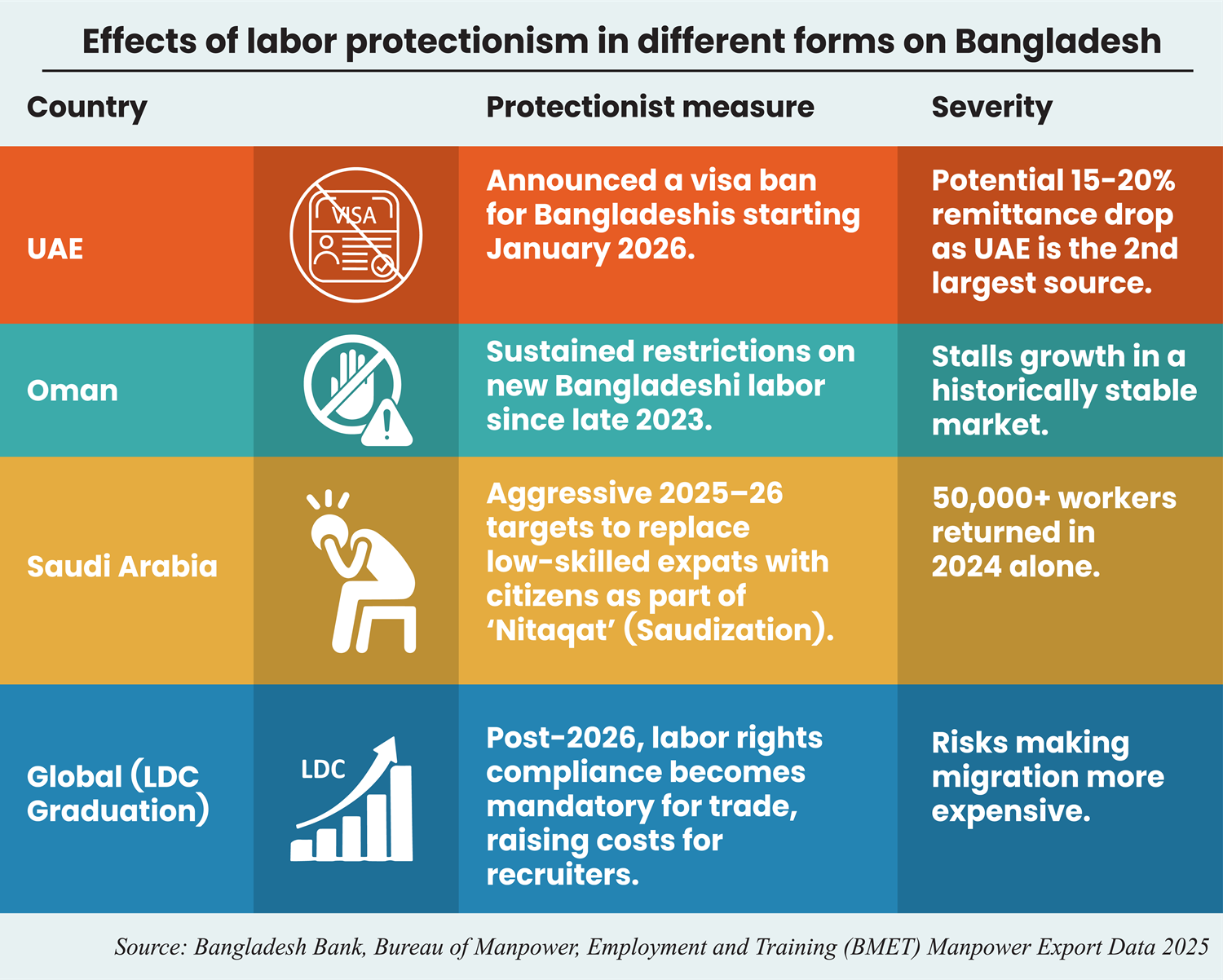
Protectionist measures in top migrant destinations
The host countries are now prioritizing their own labor markets and home-grown products. Political narratives are also influencing the recruitment process and employment conditions for migrants.
In some Gulf states, migrant laborers represent over 50 percent of the workforce, most of whom are Asian. In the Gulf Cooperation Council (GCC) countries, women migrants, mostly from South and Southeast Asian nations, represent about 20-40 percent of the migrant workforce.
Female migrants are generally hired as domestic workers. They are often mistreated and sometimes molested and abused to death. They are even more vulnerable to exploitation and unfair treatment than migrant men.
Recently, GCC countries have been intensifying the implementation of nationalization strategies to rebalance the labor market in favor of nationals, such as Saudi Arabia’s Vision 2030 (Nitaqat), which aims to raise its localization rate from 30% to 40%.
Bahrain has set a target to localize the workforce to 65-75% by 2030, and Kuwait aims to achieve 70% nationalization by 2035. Oman is going a bit slow in this regard, aiming a 30% nationalization by 2040.
All these ambitions are driven by labor-market rebalancing, addressing youth employment in the region, reducing dependence on traditional economic sectors, and diversifying the economy.
Protectionist measures are government policies designed to restrict imports and promote domestic industries by shielding them from foreign competition. These policies can safeguard jobs in the country, maintain economic stability, reduce dependence on foreign products, but can also lead to inefficiencies, higher consumer prices, and trade disputes.
The USA case
Recent restrictions on work visas, such as the H-1B for skilled workers and the H-2B for temporary non-agriculture labor, are prominent examples of labor restrictionism in recent times. These restrictions are often supported by the claim that migrant labor depresses wages for native workers and intensifies job competition.
Although inflation can counter this, acute shortages of skilled labor in industries such as agriculture, healthcare, construction, and the service sector are putting pressure on wages.
The sweeping crackdown by the Trump administration in the USA, along with its erratic trade policies, is happening on both sides of the immigration spectrum- low-wage laborers being deported and capable and trained minds being discouraged from finding jobs.
The low-wage jobs include cleaning houses, painting fences, walls, and picking fruits- the jobs most native-born are reluctant to do for the payment offered.
According to economists, immigrants support job and economic growth and help tackle inflationary surges. The immigration crackdown, which is causing labor shortages, is driving up supermarket prices and putting pressure on consumers.
From 1990 to 2010, rising numbers of H-1B holders contributed to 30–50 percent of total productivity growth in the US economy, indicating that the employment of Americans relies on these workers to a significant extent. They are the specialized workers with skills like programming, financial analysis, nanotechnology, and medicine. Studies show that firms that hire these workers on H-1B visas produce 27 percent more than other firms.
Although the USA’s labor protectionist measures will have minimal impact on Bangladesh, the country is a trend setter, and the world follows it. So, Bangladesh and other developing nations that depend on labor exports will be affected by protectionist trends.
Should Bangladesh be worried?
Dr. Deen Islam, associate professor in the Department of Economics at the University of Dhaka, shared his observations with the Industry Insider regarding current conditions in the global labor market and our preparations for adverse situations.
“Illegal and undocumented immigration are the major concerns. One is crossing the border illegally, and the other is entering countries legally for work and then getting involved in illegal activities or working without permission. These are ruining our image. We need to work to improve the country’s image to keep remittance inflows steady or increase them.”
He suggested creating more legal pathways to enter the foreign workforce and upskilling youth to meet job-market demands. Learning a foreign language might be one of the main ways to break down barriers. 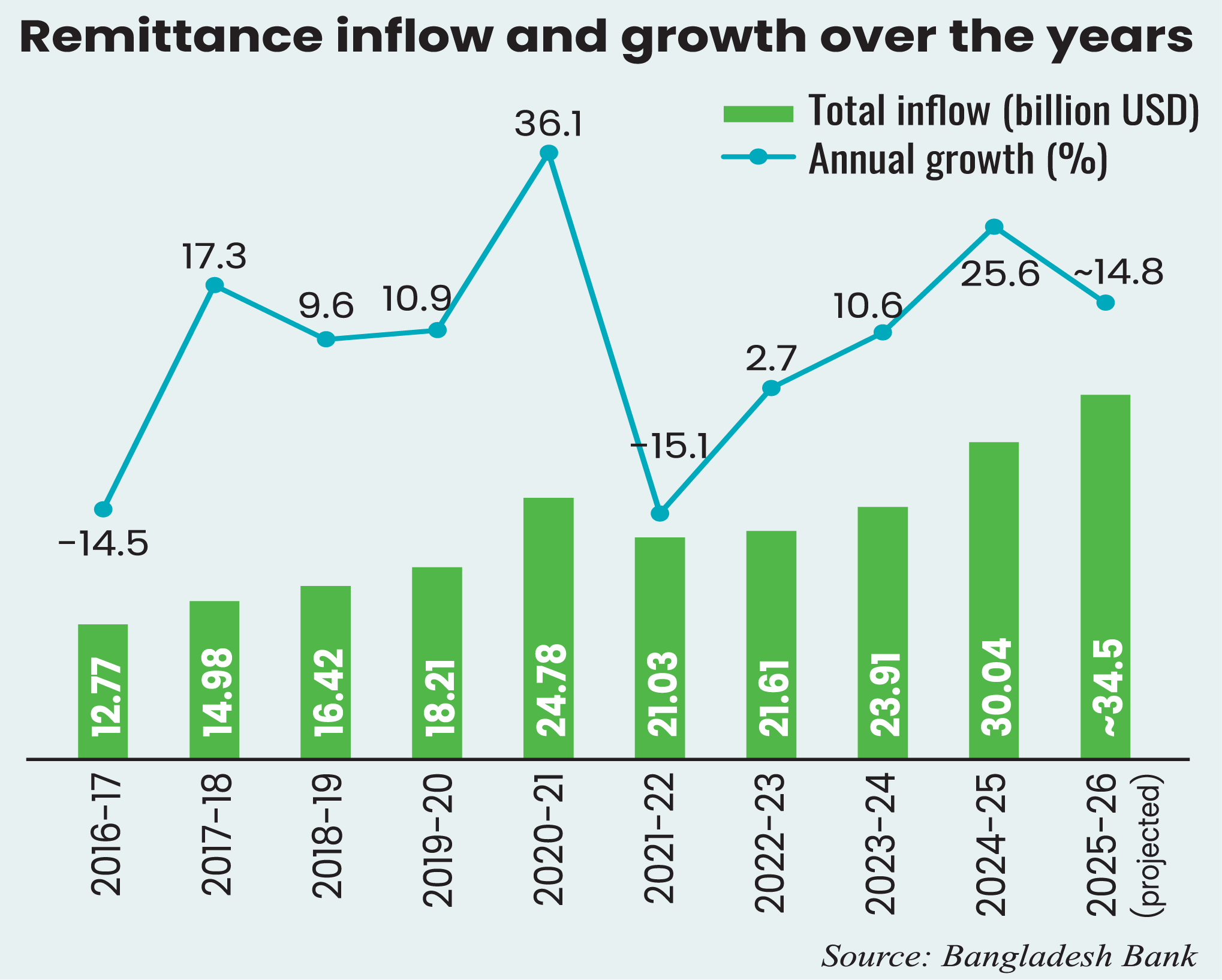
He advised against information gatekeeping, urging those with international experience to share their insights with others planning to move overseas.
There should be easily available options for creating and facilitating employment opportunities inside the country. Because a lack of opportunities makes people desperate, leading to illegal agency traps.
Dr. Deen Islam said, “Priority should be given to export-oriented Foreign Direct Investments (FDIs) that introduce advanced technologies and create high-quality employment.”
“To nurture a growth-driven environment, the government must address bottlenecks like political instability, bureaucratic hurdles, and the ongoing energy crises.”
“Cheap labor alone is no longer a primary draw for entrepreneurship or large-scale export orders; instead, a reliable energy supply is the essential catalyst for mobilizing the domestic workforce and attracting global investment,” he noted.
We need a comprehensive database of country-specific skill needs and the capacity to send skilled labor to those countries.
The Philippines’ labor diplomacy focuses on protecting overseas Filipino workers through a centralized system led by the Department of Migrant Workers (DMW). It offers services such as training, legal aid, on-site support, and post-return reintegration programs, including financial literacy.
Bangladesh should also adopt similar models and prioritize the welfare of its people. The country’s current remittance earnings can be increased manyfold with skilled labor migration. It will also make us less vulnerable to shocks from protectionist measures.
Most Read

Starlink, satellites, and the internet
BY Sudipto Roy
August 08, 2025

What lack of vision and sustainable planning can do to a city
A nation in decline
From deadly black smog to clear blue sky
Understanding the model for success for economic zones

How AI is fast-tracking biotech breakthroughs

Environmental disclosure reshaping business norms

Case study: The Canadian model of government-funded healthcare
A city of concrete, asphalt and glass

Does a tourism ban work?
You May Also Like